¶ Welcome
Welcome to Fighting Squadron Eleven, more commonly known as The Red Rippers. VF-11 aims for excellence while providing a welcoming community for all skill levels of Tomcat enthusiast. If you’re struggling with JESTER, just learning carrier operations, or settling into beyond visual range combat, VF-11 has the resources to help you reach -and stay at- the top. We can’t provide support for the Hornets if we can’t support each other, so feel free to ask our experienced members for assistance if you’re having trouble.
Rip and Tear, Baby!
¶ Squadron Administration
¶ I.I - Staff
¶ Commanding Officer (CO)
| Current Officer | CDR E. “Wiki” Crouch |
The CO is an O-5 or higher ranked individual responsible for the overall leadership and direction of Fighting Squadron 11.
Current responsibilities include:
- Setting squadron policy
¶ Executive Officer (XO)
| Current Officer | Vacant |
The XO is an O-4 or higher ranked individual responsible for the day-to-day operations of Fighting Squadron 11.
Current responsibilities include:
- Management of the roster/flight compositions
- Management of the VF-11 F-14B liveries
- Managing member promotion eligibility
¶ I.II - Pilot Standards
¶ Minimum Qualifications
The minimum qualifications required to fly during a daytime mission are the CASE I CV and pilot qualifications. Minimum qualification to participate as a RIO is the Basic RIO qualification.
The minimum requirement to lead an element as either the pilot or RIO is LTJG. Only one member has to be LTJG, but it is preferred both crew have the rank.
Leading a flight requires at least one crew member to be Lieutenant or higher. Double LTJG crews may be placed as flight leader if they so desire, but must be a cohesive team that has regularly flown together.
If a suitable amount of qualified individuals are not present for a mission, a lower rank may be tasked with greater responsibility.
¶ Minimum Participation
Members are expected to fly in official Saturday operations, in an F-14 Tomcat, with the squadron once every 60 days. Past 60 days your next operation must be in the F-14 flying with the squadron. Failure to communicate with squadron leadership during an absence longer than 90 will likely result in demotion for O-3 and above down to O-2 or removal from the roster past 90 days for O-2 and below.
¶ Leave of Absence
If you know you are going to be absent for longer than 30 days please send the XO a message. No reason is neccessary.
While on LOA, you do not need to mark your attendance for operations.
¶ Promotions and Checkrides
¶ Rank Progression & Requirements
The CASE I and Pilot Basic Type Rating, or single RIO checkride for ENS (O-1) are considered mandatory for participation in weekly operations, and new members are required to complete them within 60 days of joining.
All ENS-level checkrides may be proctored by CSG-8 members rank LT or higher.
At the time of your qualification, you will connect to a CSG-8 training server and perform a standard CASE I recovery to the best of your ability. Your exam will begin when you are outside the 50 nautical mile carrier control zone.
-
Select an airborne carrier qualification slot for your chosen airframe.
-
Fly the CASE I arrival and overhead patterns, following proper radio procedures.
-
Land on the aircraft carrier in three out of five attempts:
- Landing Signal Officer (LSO)-instructed or Own Wave-offs will not affect your score.
- Instances in which your wheels touch the deck and you do not come to a complete stop will count against you.
- For a successful landing to count, you must land inside the demarcated landing area and be able to taxi past the boundary stripes.
- Failing two or more out of five landing attempts will stop your test and you will be required to practice before attempting again.
-
After the first arrival and successful landing, your proctor may have you launch and immediately fly into the downwind leg for subsequent landing attempts.
-
Following a successful qualification, your proctor will message the squadron CO/XO or CAG if the CO/XO is unavailable and inform them you passed.
There is no rule against using the website during the exam, so feel free to have the CSG-8 carrier procedures page open when attempting qualification.
You can find the CASE I recovery patterns and radio procedures on the vCSG-8 VICTORIA through this link.
At the time of your qualification, you will connect to a CSG-8 training server and perform a standard CASE III recovery to the best of your ability. Your exam will begin when you are outside the 50 nautical mile carrier control zone.
-
Select an airborne carrier qualification slot for your chosen airframe.
-
Fly the CASE III arrival and overhead patterns, following proper radio procedures.
-
You will be directed to raise your tailhook for the first pass to demonstrate the bolter pattern
- Landings are not counted for passing, simply conducting the two required passes to standard is enough
-
Following a successful qualification, your proctor will message the squadron CO/XO or CAG if the CO/XO is unavailable and inform them you passed.
There is no rule against using the website during the exam, so feel free to have the CSG-8 carrier procedures page open when attempting qualification.
You can find the CASE III recovery patterns and radio procedures on the vCSG-8 VICTORIA through this link.
The BTR will test your basic competency flying with JESTER to navigate and employ weapons. You will need to complete this checkride while either screen-sharing or server hosting with a proctor.
-
You will take off from the aircraft carrier and fly a CASE I departure;
- Leave the carrier deck and fly the BRC of the carrier for seven nautical miles.
- Once at seven nautical miles, turn towards and rejoin a tanker aircraft waiting at 12,000 ft.
- Rejoin on the tankers left wing as if you were wanting to refuel. You may show off your refueling skills if you wish.
- Once settled (or completed refueling), transition to the tanker’s right wing.
-
Engage enemy aircraft, utilizing the AIM-54 Phoenix, AIM-7 Sparrow, and AIM-9 Sidewinder;
- Target enemy aircraft with the following sorting plan;
- Shoot right target first,
- If unable to determine azimuth, shoot trail
- Complete a stern conversion on the remaining targets and engage with an AIM-9 under 1.5 nautical miles.
- Target enemy aircraft with the following sorting plan;
-
After completion of step two, return to role select and enter the F-14 loaded for ground attack;
- Fly the aircraft through the required waypoints, following a fuel plan organized by your proctor.
- Use the JESTER AI to configure unguided bombs and LGBs; engage ground units per the in-mission brief.
-
After completion of step three, return to role select and enter the F-14B Upgrade slot for conversion training;
- Load the correct flight plan from the DTC, take off and fly the aircraft through the required waypoints and TACAN beacons.
- Use the JESTER AI to configure JDAMs and LGBs; engage ground units per the in-mission brief.
This is a link to download the current version of the checkride mission.
This is a link to download the DTC required for the Upgrade sortie.
Promotion is automatic upon participation in an official Saturday night event.
At the time of your qualification, you will connect to a CSG-8 training server and perform the basic duties of the F-14’s Radar Intercept Officer. Perfection is not expected, and your proctor may provide guidance in some instances, but please be familiar with the back seat before attempting your qualification.
- Enter the RIO seat of a cold and dark F-14B(U) in which your proctor is the pilot.
- Complete the full start up of the RIO cockpit, including the following procedures:
- Start up and basic operation of the communication & navigation systems;
- AN/ARC-182 V/UHF radio
- Link 4 Datalink system
- Operation of the AN/ASN-92 Carrier Aircraft INS and TACAN;
- Aircraft Stored Heading (ASH) alignment
- Waypoint data entry and sequencing
- Toggle between Pilot and RIO TACAN source; navigate to beacon
- Operation of the aircraft defensive systems;
- AN/ALE-39 and LAU-138 Countermeasures Dispenser Systems - Operation
- AN/ALQ-126 Defensive ECM - Operation
- Start up and basic operation of the communication & navigation systems;
- Your proctor will fly the aircraft and test your knowledge on various combat duties:
- Countermeasure employment
- Air-to-Ground;
- AN/AAQ-14 LANTIRN alignment and basic use
- Stores selection and release configuration
- LGB employment
- Air-to-Air;
- AWG-9 scan elevation and azimuth
- Switching radar modes
- Identify radar contacts through use of CAP Identification Friend or Foe (IFF)
- AIM-54 Phoenix employment
- NAV GRID setup
- Following a successful qualification, your proctor will message the squadron CO/XO or CAG if the CO/XO is unavailable and inform them you passed.
- If your proctor does not believe you are able to complete the bare minimums, your test will end and you will be required to practice before attempting again.
At the time of your qualification, you will connect to a CSG-8 training server and perform the basic duties of the F-14’s Radar Intercept Officer. Perfection is not expected, and your proctor may provide guidance in some instances, but please be familiar with the back seat before attempting your qualification.
- Enter the RIO seat of a cold and dark F-14B(U) in which your proctor is the pilot.
- Complete the full start up of the RIO cockpit, including the following procedures:
- Start up and basic operation of the communication & navigation systems;
- AN/ARC-182 V/UHF radio
- Link 4 Datalink system
- Operation of the Control Display Navigation Unit (CDNU) and Embedded GPS/INS (EGI);
- Aircraft Stored Heading (ASH) alignment
- Load Flight Plan from DTC (sample file)
- Enter waypoint data and attributes (LTS, ST) via CDNU
- Toggle BDHI data source
- Toggle between Fly-To and Destination steering modes
- Configure Bullseye waypoint
- Toggle EGI/TCN steering modes
- Operation of the aircraft defensive systems;
- AN/ALE-47 and LAU-138 Countermeasures Dispenser Systems - Operation
- AN/ALQ-126 Defensive ECM - Operation
- Start up and basic operation of the communication & navigation systems;
- Your proctor will fly the aircraft and test your knowledge on various combat duties:
- Countermeasure employment
- Air-to-Ground;
- AN/AAQ-14 LANTIRN alignment and basic use
- Pre-Planned JDAM employment using DTC
- TOO JDAM employment
- LGB employment
- Air-to-Air;
- AWG-9 scan elevation and azimuth
- Switching radar modes
- Identify radar contacts through use of CAP Identification Friend or Foe (IFF)
- AIM-54 Phoenix employment
- Following a successful qualification, your proctor will message the squadron CO/XO or CAG if the CO/XO is unavailable and inform them you passed.
- If your proctor does not believe you are able to complete the bare minimums, your test will end and you will be required to practice before attempting again.
Promotion is automatic upon participation in an official Saturday night event.
The LTJG requirements listed here must be completed if you wish to cross-qualify in either crew position.
You will connect to a CSG-8 training server, which you will be provided the info to at the time of your qual.
- Select an F-14B and configure the aircraft with the ordnance your proctor instructs you to.
- Demonstrate various communications skills:
- Perform basic Crew Resource Management (CRM) between pilot and RIO.
- Support the RIO with building situation awareness (SA) and making decisions.
- Set up and manage the AN/ARC-159(V) radio in the pilot’s cockpit such as updating incorrect frequencies.
- Perform following JESTER AI functions:
- Configure Electronic Countermeasures (ECM) with JESTER.
- Configure Air-to-Ground ordnance profiles with JESTER that include complex settings and ripple timing.
- Demonstrate knowledge of Beyond Visual Range (BVR) combat:
- Understand basic terminology and flow.
- Understand and perform basic missile defense.
- Describe AIM-54 Phoenix Tactical Information Display (TID) symbology.
- Describe and demonstrate following formations:
- Line abreast
- Parade
- Trail
- Combat spread
- Basic TACFORM maneuvering
- Perform Air-to-Air Refueling of 2000 Lbs or more without disconnecting.
- Complete CASE III recovery training/qualification:
- Follow CASE III marshall and approach procedures.
- Perform one successful recovery under CASE III conditions.
Promotion to Lieutenant Junior Grade is granted upon qualification and participation of six official events as Ensign.
You will connect to a CSG-8 training server, which you will be provided the info to at the time of your qual.
- Select the RIO seat in an F-14B that your proctor instructs you to.
- Start up and operate the AN/AAQ-14 LANTIRN:
- Utilize QWP, QDES, QHUD, QSNO to acquire lock on target(s) designated by proctor.
- Coordinate with your pilot to drop and guide laser guided bombs.
- Understand the functionality of the ordnance panels:
- Configure valid weapon profiles.
- Understand ripple times and distances utilizing the ripple function kneeboard provided with the F-14 module.
- Demonstrate various communications skills:
- Perform basic Crew Resource Management (CRM) between pilot and RIO.
- Be proactive with Interrogate Friend or Foe (IFF), radar sorting, and waypoint management.
- Be comfortable with communicating on inter and intraflight radio channels.
- Perform offensive WCS usage to engage aerial targets:
- Manage a complex IFF picture in Track While Search (TWS) and Range While Scan (RWS) modes.
- Complete a successful TWS engagement.
- Search and track air and surface targets using Pulse Search.
- Know the auxillary radar functions such as TGT SIZE and ASPECT.
- Use the Tactical Camera System (TCS) to visually identify targets.
- Understand basic BVR terminology and flow.
- Describe and complete defensive maneuvers:
- Understand and employ the AN/ALQ-100 AND ALR-126 Defensive Electronic CounterMeasures (DECM) panel.
- Describe and lead the pilot to complete basic missile defense.
- Understand and manage nonstandard countermeasure loads.
- Perform navigation and auxillary tasks:
- Establish Navigation Command and Control Grid (NAVGRID) to locate and share target locations.
- Ascertain current position of the aircraft without using the F10 map.
- Perform a visual INS update.
Promotion to Lieutenant Junior Grade is granted upon qualification and participation of six official events as Ensign.
Pilots and RIOs have a shared set of learning objectives to acheive the rank of LT, through which they will demonstrate basic flight leadership skills.
- Perform a flight briefing
- Fill in miscellaneous data (A/A TACAN, shot ranges, et al.) and give explanations
- Explain all critical review points (i.e. sorting doctrine)
- Describe critical performance numbers for F-14
- Generate fuel ladder for mission
- Generate a DTC for a mission
- Lead a proctored flight on the training server
- Lead formation in TACFORM maneuvering
- Lead formation in air intercept
- Lead formation in Case I recovery
- Lead a proctored flight in a weekly mission
Reserved for the most dedicated of vCSG-8 members who consistently participate in the betterment of the squadron and/or group at large. This rank is presented by a squadron’s Community Admins based on needs or exceptional merit.
¶ Group 1 - Competency
The member must hold all of the following qualifications:
- CASE III (Navy)/IR (AF)
- All of the member’s squadron’s relevant aircraft competency checkrides
- Including NFO qualification if available in two-seater aircraft
¶ Group 2 - Support Roles
The member must be proficient in at least one of the following support role qualifications:
- Air Intercept Controller (AIC)
- Landing Signal Officer (LSO)
- Air Traffic Controller (ATC)
- Airborne Forward Air Controller (FAC-A)
¶ Group 3 - Administrative Duties
The member must participate in at least two of the following administrative duties in either their squadron and/or vCSG-8 at large:
- Schedule and host group training nights, or consistently produce training products
- Roster administration, including attendance, event flight composition, and promotion chart
- Recruitment administration
- Mission making or regular CAOC participation
- Systems administration
¶ Group 4 - vCSG-8 Values
The member must demonstrate all of the following:
- Actively helps those that seek assistance with their aircraft, training, technical issues, or questions
- Upholds all vCSG-8 rules and helps to present vCSG-8 in a mature and welcoming light
- Drives discussions about the group’s current state and future state and is an active voice in the group
¶ Livery Policies
Refer to the CSG-8 rules on liveries.
| Rank | Livery |
|---|---|
| OC-ENS | Assigned random modex 101-116 per mission |
| Pilot LTJG+ | Finalized modex 103-116 w/ Name + Custom Helmet |
| RIO LTJG+ | Helmet will be assigned to a random, preoccupied modex unless the RIO has a permanent pilot |
Crew position availability may depend on preference of current occupant, unless there are no free modex with that available position. Current modex owner may request a permanent partner, only if the second crew member is LTJG+.
| Modex | Availability | Modex | Availability | |
|---|---|---|---|---|
| 101 | Pilot | 111 | RIO | |
| 103 | Both positions | 112 | Pilot | |
| 104 | Both positions | 113 | RIO | |
| 105 | RIO | 114 | Both positions | |
| 106 | RIO | 115 | Pilot | |
| 107 | Both positions | 116 | Both positions |
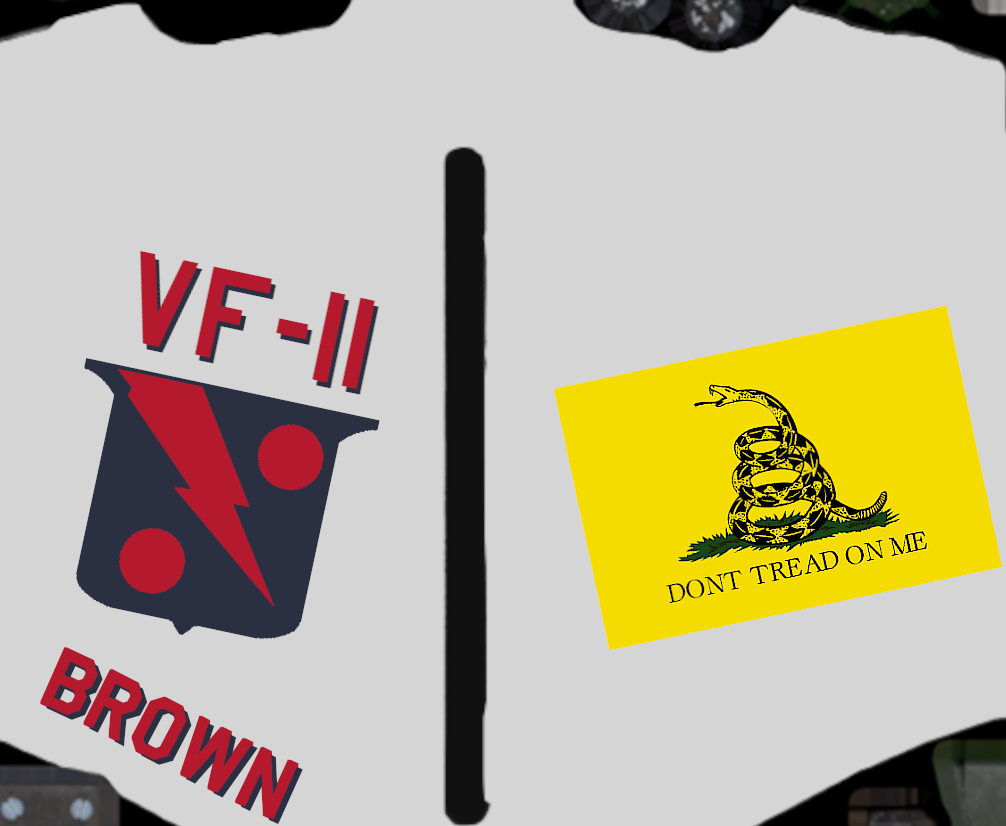
- Helmet: Aircrew will be given a helmet upon promotion to LTJG, which they can have customized to their liking, so long as it is compliant to the CSG-8 rules. CO/XO have final say on helmet designs. All helmets must contain the member’s name/callsign and VF-11 in Amarillo USAF or USN Stencil font, and at least one VF-11 Boar’s head. The boar’s head may be modified in color or design, as long as the head is still recognizable:

- Name: Aircrew ranks, names, and callsigns will be placed on the side of the canopy frame.
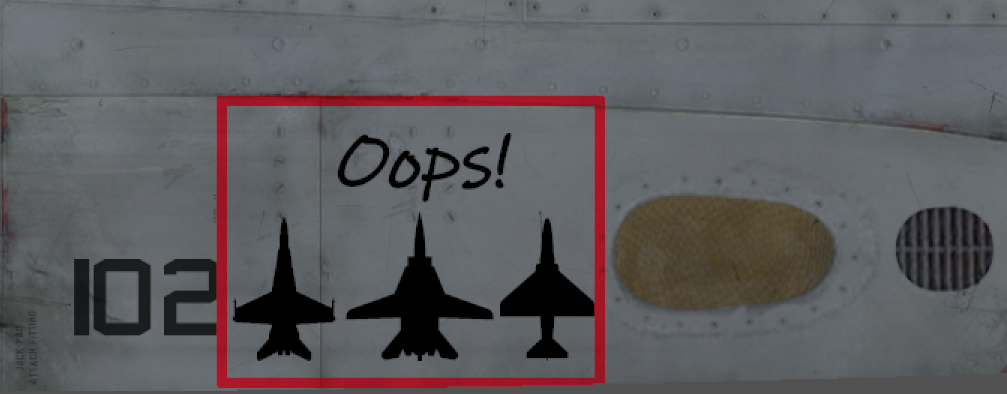
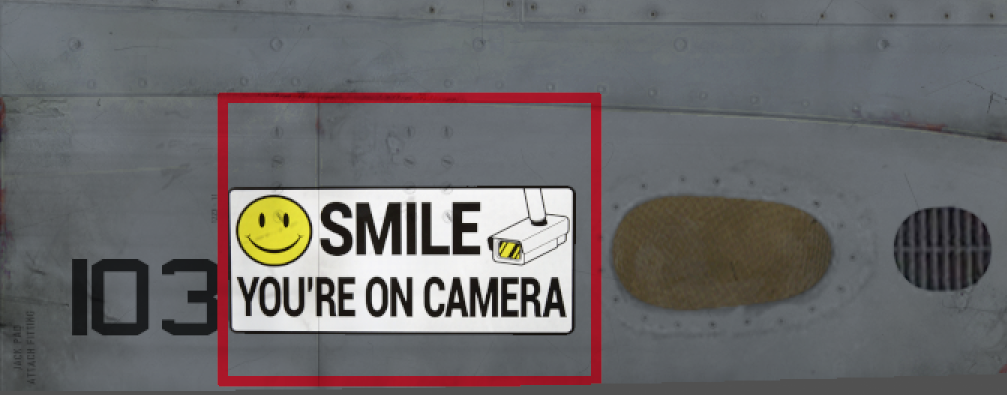
- Nose door: Permissible artwork on your aircraft may only be placed on the port door, between the modex number and RWR sensor. A total of five colors may be used, preferrably in shades of black, white, and grey. Designs must be CSG-8 complaint, and CO/XO get final say on approval.
Artwork must fit within the designated box:
- Victory Marks: While flying in a VF-11 aircraft during an official operation night (Fridays or Saturdays), in an internally built campaign (no server raids), you are eligible to recieve victory art based on the following criteria:
| Criteria | Victory Mark |
|---|---|
| Ace-In-A-Day: Credited with 5 enemy air kills in a single sortie. Only hostile aircraft produced post-1965 count towards the tally. |  |
| Clean Sweep: Participated in a flight of two or more aircraft, with every aircraft in the flight earning at least two kills and successfully landing aboard the carrier. Awarded to each aircraft of said flight, with a date of achievement. Can only be achieved by each participant every 60 days. |  |
| Precision Excellence: Participated in a flight of two or more aircraft, with perfect GBU-12/16 accuracy from an altitude of 17,500 ft AGL. |  |
Crashing to desktop does not affect your tally, if you choose to rejoin the mission. Getting shot down or landing ends your tally. In order to achieve a victory mark, you must self-report with a Tacview or mission title for cross-reference.
¶ Resources
- Fighting Squadron 11 Standard Operating Procedure (SOP) Tactical and Administrative procedures specific to VF-11.
- vCSG-8 Standard Operating Procedures
- vCSG-8 Carrier Procedures
- Radio Brevity or: How I Learned to Stop Worrying and Talk Quickly.
- vCSG-8 Intelligence Library
The SOP is intended to give our members an idea of what we expect of them, what skills we think are important for playing DCS in a multiplayer setting, and what procedures we follow in our missions. It should mostly be considered a list of suggestions - this is a video game, after all - but large portions of it will be considered required knowledge for promotion.